In the West you often hear of cities seeking new water supplies by prodding farms to conserve, thereby freeing up water that can be transferred from ag uses to urban uses. But this article from Durango, CO discusses efforts in that state to encourage additional urban conservation in order to maintain ag uses. Colorado has seen fairly aggressive efforts to re-allocate water from ag to urban in recent decades and there has been a lot of concern about the effects this will have on rural communities if irrigated agriculture starts to dry up.
California and New Mexico have also had experience with this and similar concerns. This concern shot down legislation that would have created a mechanism to finance water transfers in Arizona last year. So now the farming communities are looking for ways to protect their economies and the farmers that support them. It's a conversation worth having.
Showing posts with label Western water news. Show all posts
Showing posts with label Western water news. Show all posts
Thursday, January 30, 2014


Monday, September 16, 2013
Might be time to try a little forebearance
I've been too busy to post anything on the recent announcement by Reclamation that a shortage declaration on the lower Colorado River is likely by 2016. But when I spotted this (pdf) on the agenda for the most recent board meeting of the Central Arizona Project, it seemed like a good time to chime in.
The fallowing and forebearance agreement between CAP and the Yuma Mesa Irrigation and Drainage District (YMIDD) is a first step to developing a relationship between water users in Arizona along the River and in the Central part of the state to try to forestall shortages to CAP customers.
The fallowing and forebearance agreement between CAP and the Yuma Mesa Irrigation and Drainage District (YMIDD) is a first step to developing a relationship between water users in Arizona along the River and in the Central part of the state to try to forestall shortages to CAP customers.
Tuesday, July 9, 2013
Group Dedicated to Restoring Glen Canyon Wants More Water in Lake Mead and Less in Lake Powell
This article was sent to me in an email earlier this week. As you might have guessed from the headline, I think their plan is a little self-serving. That's not to say it is clearly without merit. I don't have access to the study their conclusion is based on, but I would be very interested to read it.
I agree that seepage into the Navajo sandstone that borders the lake could soak up a significant amount of water stored there, but wouldn't much of what enters the rock during high water periods later exit the rock when the water is low? Admittedly, some of that water would be bound up in the rock matrix over time, but once that matrix porosity has been filled it can't be refilled again. So in some sense, the damage has been done and won't be undone by changing the management strategy of the reservoir. But I would like to see the data and calculations or models that were employed to get a better sense of how they reached their conclusions.
I agree that seepage into the Navajo sandstone that borders the lake could soak up a significant amount of water stored there, but wouldn't much of what enters the rock during high water periods later exit the rock when the water is low? Admittedly, some of that water would be bound up in the rock matrix over time, but once that matrix porosity has been filled it can't be refilled again. So in some sense, the damage has been done and won't be undone by changing the management strategy of the reservoir. But I would like to see the data and calculations or models that were employed to get a better sense of how they reached their conclusions.
Sunday, January 6, 2013
Can Reclamation Change its Ways?
There has been lots of chatter in the blogosphere and elsewhere about the recently released Colorado River Basin Water Supply and Demand Study from the Bureau of Reclamation (BOR). This really is a ground-breaking study in many ways: it enshrines the likelihood that climate change is likely to have an impact on water supplies in the basin in the future; it acknowledges that the lower basin is already out of kilter in the supply vs. demand equation, and is highly dependent on deliveries of excess water from the upper basin to continue meeting that demand; and probably biggest of all, it largely acknowledges that the era of large public works projects to address water needs is probably over.
Tuesday, October 23, 2012
Cato Article - Downsizing the Federal Govt. - BuRec
There's definitely some Cato Institute stuff that's just too far out there for me, but when they take on federal control of water resources in the West and advocate for more use of markets to allocate a scarce resource, they can probably reel me in. I enjoyed this article, mostly for its advocacy of water markets. I think it's easy to find examples of where the federal government has screwed up in their long-standing management of Western water and they do a good job of chronicling those in the article. But they largely overlook much of the good that has resulted from those efforts - the Colorado being a prime example of both the good and bad of what the Bureau has done.
We would not have the infrastructure that is needed to weather extremes of climate, like we have been experiencing the last couple of decades in the Colorado basin were it not for the extensive infrastructure built by the Bureau and that infrastructure could not have been built by any smaller unit of government. We also could probably be figuring out better ways to manage the water of the basin if it weren't for ongoing federal control of the basin and all that infrastructure. But the Southwest that we currently have - good and bad - clearly wouldn't be around today if not for what the Bureau did with the Colorado.
And the article clearly does a much better job of chronicling what's wrong than of proposing workable solutions. That's think-tank work for you. But still a pretty good article if you swing toward the free-market side on water management.
hat-tip to Marginal Revolution for the link that eventually led me to this article.
Sunday, October 17, 2010
Lake Mead expected to hit historic low today. Is anyone paying attention?
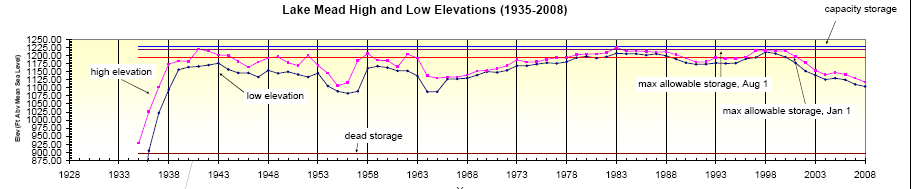
John Fleck is winging his way to Lake Mead to observe an historic event expected to occur later today (10/17). As I'm writing this the water level elevation in the reservoir is at 1083.2 ft. As John points out, the lowest level the reservoir has ever seen (except when it was filling after first being constructed) was back in 1956, when it dropped to 1083.19, during what had been the historic drought of record for the river basin.
This is momentous for water geeks like John and I who love to observe the significance of historical events, but probably not so momentous for the average person. The number that should have great significance, especially for anyone who relies on water from the Central Arizona Project, is 1075. That is the elevation at which Arizona's share of Colorado River water will be reduced under the Shortage Sharing provisions adopted by the basin states a few years ago. Many water managers in the Southwest think it's likely the reservoir will reach that level as early as next year.
When the level of 1075 ft is reached, Arizona (specifically the Central Arizona Project) will have it's water delivery reduced by approximately 300,000 acre-feet. That's enough water to irrigate about 50,000 acres of alfalfa in central Arizona, or enough to provide municipal supplies to a city of almost 1.5 million people for a year. Does this mean any cities in Arizona will have to cut back on their water deliveries. No. This means that the amount of excess water being taken by Arizona mostly to recharge aquifers in the central part of the state will be reduced. Some farms will probably have to go back to pumping groundwater, but no municipal or industrial supplies will be affected until reductions become much larger - an unlikely occurrence in my lifetime.
But I can't help but wonder - what is the average Arizonan, who doesn't track these kinds of issues on a regular basis going to think when they hear Arizona's allocation from the Colorado River is being cut because of shortages on the river? Will they drill deeper and learn that the water they use in their home will be unaffected? Will they panic and start extraordinary conservation measures? Or will they look to move somewhere else?
I don't know how much resource managers in Arizona are thinking about these questions or if they have developed strategies to get the right message out to the public, or even thought about what the right message is. Do you tell people not to worry or do you say this a real threat to the continued viability of some communities in this state? I'd like to know if there are answers to these questions, because I don't have them and I think they are needed.
Monday, June 8, 2009
A couple of recent articles discussing improvements in irrigation efficiencies by farmers in Ariz. and Cal.
I thought these two articles were very encouraging in showing that farmers in the West (even the ones growing alfalfa) can invest in improved irrigation efficiency and have a positive impact on their bottom line. With all the recent bad news about climate change and diminishing water supplies it's going to be necessary for farmers to adapt and alter their operations if they want to survive as farmers and if we want to continue to grow crops locally, here in the West.
The first of these articles appeared in the Western Farm Press last month and describes a farming family in Central Arizona that started growing alfalfa in fields where they had already installed drip tape and found their yields were enough higher than their neighbors that they claim a system like it can pay for itself in 3 to 5 years.
I confess, I don't personally know enough about irrigated farming or growing alfalfa to properly evaluate these claims, but what I have always heard is that it just isn't economical to install high-efficiency irrigation systems in alfalfa fields because it's considered such a low value crop. Maybe higher prices for alfalfa in recent years have altered the equations sufficiently to make things like drip tape a good investment. But I think the key in this story is that the drip system was already installed in the field for growing things like cotton and wheat (not really high value crops themselves in most years, but probably better than alfalfa). The other thing the story doesn't discuss is the overall effect on consumptive use of water with the drip vs. flood irrigation. Some investigations have indicated higher consumptive use with drip, meaning that any savings in overall water use are illusory because the return flow component of flood irrigation is lost. But this clearly is the most efficient way to irrigate crops.
The second article appeared this week in the Fresno Bee (and I lifted it from Aquafornia - thanks Aqua Blog maven!). The article discusses farmers in the Central Valley of California switching to center pivot irrigation systems to get more crop per slowly shrinking drop of water available. Most farmers growing row crops in that area have always used flood irrigation, probably because there has historically been a reliable supply of cheap water available so there was zero incentive to switch to higher efficiency systems. Some farmers are now finding it worth their while to make investments (and apparently finding sympathetic bankers in the area willing to finance those investments - a very important and often overlooked point) in higher efficiency irrigation systems.
These articles show the ability of farmers to adapt to changing conditions and remain profitable in their farming operations. It would be very interesting to look at how many farmers are actually making changes in these difficult times because all you seem to hear about are how farmers are being forced out of business because the water isn't there and they just can't cut it without intervention to supersede environmental laws and more taxpayer funded water storage projects. The Pacific Institute released a report last year outlining steps that could be taken by farmers to implement water conservation measures potentially freeing up more than 3 million acre-feet of water in Central California. I saw a fair amount of criticism of that report as being unreasonable in its assumptions. Obviously there are efficiency gains to be made out there because these articles show that it is happening. But I don't think anybody really knows the extent to which it could occur, or how much it might cost. These would be good things to know.
Monday, April 20, 2009
Grim predictions for Colorado River
Click on the chart to see the entire image.
This post from Tom Yulsman on the Center for Environmental Journalism website paints a picture of a pretty grim future in the Colorado River watershed. When you have combined trends of steadily increasing water use with a likelihood for steadily (or is it abruptly?) decreasing river flows the outcome of dry reservoirs appears unavoidable, unless some drastic changes are made. The question is: is the Law of the River robust enough to make those drastic changes? Or do we need to scrap it and start over?
Hattip to John Fleck for pointing me to the CEJ post and providing the image above.
Thursday, March 12, 2009
Three recent articles on Reuters about water problems in the West
Reuters News Service has been focusing on water a bit this week. Hard to say why. Maybe because it's National Groundwater Awareness week or maybe it's just because the State of California is all in a tizzy this winter over drought, climate change, ecological calamity, agricultural decline, etc. because there just isn't enough water in the state any more to meet all the competing demands being placed on it. If you haven't taken a look at the Aquafornia blog in a while you should, just to get caught up on the latest round of finger-pointing going on over there.
But back to Reuters. First there were two articles on Tues. the 10th, one discussing impending water crises in the West resulting from rapid growth dependent on occasionally unreliable water supplies and the second discussing the limited options available for water managers to stretch existing, thin supplies or augment supplies. Then on Thurs. the 12th, they carried an editorial, written by a former head of the California Department of Water resources and current water policy advisor for an environmental advocacy organization, comparing current water crises in the West with the current financial crisis - both caused by growth based largely on speculation (that the water would keep flowing in one case and money in the other). He makes some good suggestions for improving water use efficiencies in the residential sector but that's pretty small potatoes in the overall water picture.
If we want to adapt to new climate realities and maintain our quality of life we will need big changes in how water is allocated and priced (and those two things are highly interdependent) before too long.
Subscribe to:
Posts (Atom)